26 May 2008

Do we have the minimum wage to make ends meet?

Singapore does not have any minimum wage law and does not implement a minimum wage system. It postulates that wages should be determined by free market forces of supply and demand. Employers and workers should be allowed to negotiate and mutually agree on the wages to be paid before they enter into an employment contract.

The National Wages Council (NWC) was established in 1972 to advise the government on wage policies and also issue wage guidelines in line with long-term economic objectives. The NWC’s recommendations, when accepted by the government, serve as a basis for wage negotiations between employers and unions. NWC’s recommendations apply to both the public and public sectors

The key function of the NWC is to enhance Singapore’s competitiveness in global markets by adjusting wages in an orderly manner. With this as its purpose, the goal of the NWC is to recommend wage policies and guidelines that attract foreign direct investments into the country, and in its process provide jobs for its local and overseas residents.

A minimum wage is defined by International Labour Organization as:

The minimum amount that must be paid to the majority of the workers of a country, generally on an hourly, daily or monthly basis; and which is ideally fixed in such a way as to cover the minimum needs of the worker and his/her family, in light of the prevailing national economic and social conditions.

According to the conditions for work and employment information sheet published by the International Labour Organization, minimum wage laws are now enforced in more than 90% of all countries.

Adjustments to the minimum wage are driven by two criteria: social, and economic. The social criteria takes into account the needs of the workers and their families, the cost of living and / or inflation, general level of wages, and the level of social benefits. The economic factors are the economic situation and / or development of the country, the capacity of enterprises to pay, employment, and productivity.

There have been commentaries on introducing minimum wage legislation in Singapore. Many supporters of the minimum wage assert that it is a matter of ethics and social justice that helps reduce exploitation and ensures workers can afford what are considered to be basic necessities. Others, however, claim it hurts businesses by reducing profit margins, and also increases unemployment. While the discussion on minimum wage continues, Singapore (Incorporated) does not have a legislation on minimum wage.

The National Wages Council (NWC) has completed its deliberations on wage and wage-related guidelines for 2008/2009. In its deliberations, the Council took into account the prevailing national economic factors, such as its economic performance, labor market conditions, productivity, wages and inflation trends, Singapore's cost competitiveness, uncertain economic outlook, and high inflation.

The Singapore government has accepted the NWC’s recommendation covering the period from 1 July 2008 to 30 June 2009. As in previous submissions, the recommendations by NWC were driven mostly from an economics perspective such as affordability of employers, increase in productivity of workers, and wage flexibility.

In addressing the high inflation in Singapore, the council recommends a one-off special lump sum payment for rank-and-file workers with heavier weightage for low wage workers. The one-off lump sum payment has been hailed by main stream media as an innovation of NWC, and was reported to be widely received by both employers federations and union members.

Although the lump sum inflation buster payment is meant to assist rank and file workers to make ends meet, the council could not prescribe the quantum to be payable. Hence, the amount of the one-off lump sum payable and its implementation are left to the creativity of companies and perhaps the devices of compensation and benefits practitioners.

NWC recommendations on wage and wage-related guidelines did not, in my opinion, delve adequately into the social factors such as the ability of workers to pay for what are considered to be basic necessities. As inflation sets in, a higher benchmark in terms of pricing for a basket of food will be re-established, and the affordability of workers to purchase basic necessities threatened.

Why do workers work? At the basic level, rank and file workers work to bring bread (and rice) to the table for themselves and their families. With the price of food and commodities reaching dizzying heights, are they still able to bring bread crump to the table?

Singapore could introduce an inflation-indexed wage system for its rank-and-file workers. Inflation indexed wage system means that wages would automatically go up by the extent of consumer price index (CPI) increase. The idea of an inflation-index wage system is not far fetched because the CPI indicator may be embedded as a key performance measure for rewarding public service administrators. Perhaps, the amount of the one-off special inflation buster pay could be index to consumer price index, and made variable according to employee levels. After all, the one-off special lump sum payment recommended by the NWC is intended to fight inflation, or isn't it?

Will we have the minimum wage to make ends meet?

25 April 2008

Paying for non-performance?

In a commentary dated 15 December 2007 on “money not enough?” the issues of pay for performance were explored. As discussed, compensation of chief executives and senior management of private enterprises have been under scrutiny by stakeholders. Stakeholders are utterly disgusted at the manner senior managers reward themselves regardless of company performance.

Although the westernised idea of paying for performance has been embedded as the reward strategy in many organizations, the question of paying for whose performance is pertinent. Are we paying company directors, chief executives and senior managers of organizations for their performance such that we may ultimately be “rewarded”? Or, are senior managers paying themselves handsomely for their own “performance”, even to the extent of behaving fraudulently to satisfy their greed addiction.

One need to go no further than to examine the classic case of Enron to understand why pay for (whose?) performance led to the collapse of the organisation. More recently, the collapse of Opes Prime in Australia wiped out millions of dollars of pension funds; First Capital suffered similar fate, and most recently, Victorian stock broking firm in Geelong, Australia has allegedly been behaving badly.

As the economy is flushed with more money and ready credit, greed had consumed some of us, allowing us to be extremely creative in feeding our greed addiction. As an example, the work performance of a loan officer is measured on the amount of credit that is booked for a given period. To secure higher book value, a bank credit officer may resort to unconventional means of earning performance bonus by offering higher credit to its customers, often ignoring their ability to service loans. Hence, many of us have continually been seduced by financial institutions offering pre-approved increases on credit cards limit, or re-financing homes with subsequent mortgages without much effort or difficulty.

For many years, organizations embrace pay for performance as the panacea for driving desired behaviours towards cash and more cash, often ignoring behavioural integrity, ethics or legal considerations. Edward Lawler III, an authority in compensation management once argued against the effectiveness of pay for performance in “why is pay no longer an incentive to better job performance".

Another commentator, Michael de Beer suggested that careful efforts to design an incentive system to make pay contingent on performance may be misguided, and raised questions on the worldwide trend towards the use of more executive incentives. However, many organisational practitioners are still paying extraordinary attention to pay for performance.

Perhaps, it is the idea of pay for performance, but whose performance? Are practitioners familiar with the notion of pay for non-performance?

The notion of performance based pay is rather complex. There are research conducted on pay and performance and on the causation between risks and rewards; the higher the risk, the greater the rewards.

For an economist, pay for performance is grounded on the theory of incentives known as the agency theory. Agency theory, also known as the principal-agent model presupposes the association between time and effort. The employee may influence the amount of work accomplished, by exerting himself, but he cannot control output entirely, because his work performance may not entirely under his control.

Under the agency model, the employee is assumed to be averse to both effort and risk. If an employee is effort averse, then incentives must be designed to get the employee to exert himself. As the employee is also risk averse, the question of tradeoffs between an employee and the employer sharing the risk is pertinent. Risk is in the balance.

As work performance may be beyond the control of the employee doing the work, pay for performance may perhaps be labeled appropriately as pay for effort. Hence, we find ourselves in a flurry of activities, as we are measured on the amount of noise we generate, and not on work related performance.

From a principle-agent perspective, the moral hazard of pay for performance is pertinent. Moral hazard is defined as the ‘‘actions or in-actions carried out by the agent that are unobservable by the principal’’ When the actions of the agent are unknown and cannot be evaluated by the principal, the principal’s ability to enforce the agency contract is hampered. Senior managers control organizational resources and know most about the organization’s activities; this allows them to act opportunistically to the detriment of shareholders.

Because of their superior information and shareholders’ lack of full observation, managers can take actions that will maximize their rewards; but their actions may harm organizational performance in the long run and result in losses to the principals.

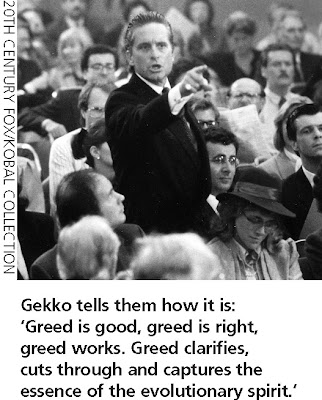
In the words of Gordon Gekko, “greed is good, greed is right, greed works, greed clarifies, cuts through and captures the essence of evolutional spirit”. Based from the collapses of organizations involving billions of dollars, is greed really good especially if pensions are wiped out almost completely overnight. Fortunately, the Central Provident Fund of Singapore manages pension of Singaporeans. At least, our superannuation are bolted under lock and key. Otherwise, we may suffer the same fate as the Australians that invested with the likes of Opes Prime et al. Trust is definitely in the balance.

Perhaps, pay for performance may actually be misguided as it will fuel more corporate collapse.

Should we continue to pay for non-performance?

15 March 2008

An employer's dilemma?

The question of “can we work anywhere we please so long as we get the work done” is pertinent for instituting a work-life balance policy in an organization. Are flexible working arrangements and unstructured work environments crucial for recruiting and retaining talented people? A recent report suggests that "shoo-ing workaholics out of office" may be the answer for a Singaporean mid sized law firm.


http://www.todayonline.com/pdf_main.asp?pubdate=20080314

In Singapore,
the year 2007 ended with “money” talk. With an extremely competitive labour market, cash and more cash were thrown at people, particularly talented people to attract, and retain them. While this “old school” approach appears effective until greed consumes some of them, practitioners are focusing on non-cash compensation to engage talented employees to “keep you in business”.

It has been reported that organizations are pursuing non-cash compensation solutions. About 53 per cent of the organizations in a survey offer opportunities for continuous learning. Others cite improving work-life balance (49 per cent), improving staff engagement (31 per cent) and faster promotion (30 per cent).


Before we rush into creating innovative non-cash compensation solutions to attract and retain talented local and foreign people, it is important to realize that non-cash compensation solutions may be workable only if salaries are attractive and competitive.


From employees' perspective, cash compensation is normally not swappable with non-cash compensation. While we attempt to carve out current cash compensation to fund non-cash compensation items, employees perceive intangible benefits as entitlement. Carving out cash compensation to fund additional employee benefits are often perceived as a reduction in salary.

Should additional benefits to be introduced in organizations be carved out of their current compensation? Cognitively possible, but emotionally difficult to implement.


http://www.todayonline.com/pdf_main.asp?pubdate=20080315

Perhaps, the dilemma for employers is the spiraling wage costs. "Will spiraling wage costs scare away business?" An economist with the Singaporean UOB Bank did not think it will. Other advantages, according to the UOB economist, such as "a high quality of manpower, transparency and efficiency, and good infrastructure are what continues to attract businesses here.”

We assumed a causation between productivity and wages ; if productivity leads wages, there is no real cause for concern. But then, the concept of "productivity" is continually abused by government agencies to justify for spiraling wage costs, and increases in the cost of conducting business. Regardless, spiraling wage costs is still a cause for concern even if productivity leads wages.

An employer's dilemma is not so much as to offer innovative employee benefits to attract and retain talented people. What is most pertinent is the costs of providing for intangible benefits.

Human resource management practitioners may not be comfortable with the mathematics of actuarial science, financial modeling and life-choice simulations. Hence, the cost of non-tangible benefits may not be computed and thus, unaccounted for. We may be in for a rude shock if we compute the total costs of providing non-cash compensation to employees.

Where benefits are offered to employees, it may be difficult to swap them for other benefit items, or withdrawn from employees when dated. This is the main reason why organizations continue to "grand-fathering" dated benefits that were once offered to employees.

The dilemma of employers is the unseen costs of providing non-cash compensation to employees, talented or otherwise.

05 March 2008

Never mind the rising rentals, really?


http://www.todayonline.com/articles/241170.asp

31 January 2008

Can we work anywhere we please so long as we get the job done?

One of the most difficult question facing employers is on “how to keep the people who keep you in business”. As history reveals, the traditional method to attract and retain talented people is to throw money and more money at them. While this “old school” approach appears effective until greed consumes some of them, an appealing solution is to engage talented employees particularly the younger generation with flexible work practices.

According to Marcia Hall, owner of Reputation Counts, an American Severna Park-based firm that provides workforce development and productivity training, a work-life balance is particularly important to members of the "millennial generation" who were born in the early 1980s. They not only grew up under intense pressure to get into the best schools but also have become more aware of their mortality with the terrorist attacks of Sept. 11, 2001, and other tragic events, she said. "The effect has been that their tomorrow is unpredictable," Ms. Hall said. "That means time for family and time for their personal life."

Money isn't the key to keeping Kiwi workers either - it's improving their work-life balance and supporting their careers. Remuneration consultants DSD Consulting reported on the importance of work life balance in their recent remuneration and market trends survey of 65 leading companies in New Zealand.

"Companies need to realize that, for many New Zealanders, their career and work-life balance is increasingly important. They want to work and be appreciated for what they do but they also want to be able to spend time with their families and pursue their other interests," says DSD director Susan Doughty.

DSD says the research shows bosses also need to accept that Generation Y employees don’t stay in jobs more than three or four years, so notions such as long-service bonuses don't appeal anymore. Employers need to think differently to remain interesting to their work force, especially when unemployment is so low and jobs are readily available.

Technology has allowed people to stay connected from anywhere. Perhaps, flexible working practices and "family-friendly policies" that help employees achieve a balance between work and life should be the alternate reward management practice as baby boomers retire later and employers search for talented people in a tight labor market.

With escalating fuel prices, additional taxi fee surcharges, increase on mass rapid transport (MRT) and bus fares, and more recently, an increase in the number of electronic road pricing gantries in Singapore, there is really no merit in merit pay increase.

Compensation and benefits management practitioners need to work harder than simply rely on benchmarked salary surveys to stay on the job. Instead of the 5 C’s in Singapore, "we talk about the four Fs being the key to what employees value - that's finance, future, fun and features. It's the combination of pay with a range of other factors - both financial and non-financial - that determines whether your staff will stay or not." DSD director, Una Diver commented.

Should we rethink the traditional boundaries of a “9 to 5” workday? Are flexible working arrangements and unstructured work environments crucial for recruiting and retaining talented people? Can we cultivate a flexible work culture by allowing people to work anywhere they please so long as they get the job done. Can we retain employees by introducing job sharing?

More importantly, can we work anywhere we please so long as we get the job done relevant to the (overseas)Chinese work communities?

18 January 2008

Is there merit in merit pay increase?

In a statement released yesterday, ECA International, a global association of human resource practitioners says that Singapore workers can expect their pay to go up by an average of 5 per cent in 2008 as compared to last year's average increase of 4.5 per cent. However, inflation is likely to take a big bite of that pay rise.

According to the ECA report, the surge in prices of oil, food and lodgings will 'counter-balance' the projected big pay rise 'considerably'. With Singapore workers looking forward to some of the biggest pay rise in the developed economies, real take-home increases will be 'relatively subdued'. Most other developed economies in the ECA survey are showing forecast wage increases of approximately 4 per cent.

'This latest upswing in inflation, which has caught many people by surprise, will have an impact on real salary increases in 2008,' said the firm's general manager. Employees in Singapore are likely to experience relatively subdued real income rises and employers may have to budget for higher salary increases next year to make up for this year's relatively low increase in real incomes.

If compensation practitioners are considering an upward revision in their forecast salary increases to retain talented employees, they should instead consider the merits of merit pay. Are merit pay increases simply employees’ entitlement based on cost of living adjustment (COLA), or are merit pay increases really based on merit?

According to the Business Times report dated 10 January 2008, Singapore’s inflation rate could soar past 6 per cent in the current quarter, beating previous estimates, as an upward revision of the value of public housing kicks in this month and food and oil prices continue to climb. If employees perceived merit pay increases as entitlement for COLA, there may be an reduction in their real take-home pay.

The concept of merit pay has been around for some time. Evans (1970) believed that merit pay has its origins in the sixteenth and seventeenth centuries with the Protestant Reformation. The protestant work ethic, which views man as competitive and individually oriented, emerged from the belief that economic success was evidence that a person who worked hard was serving God; material success was equated with spiritual purity. Thus, according to Evans (1970), performance-based pay plans continue this theme by rewarding those who have worked the hardest and contributed the most.

It appears logical to base merit pay upon performance, or is it? Commentators say that merit pay plans based upon performance can have many defects, including improper design and implementation; difficulties in paying for individual performance; lack of conviction on the part of employees that pay is really linked to performance; inadequate or inappropriate objectives, criteria, and measures; as well as other shortcomings.

Merit pay continues to be a popular vehicle for rewarding employees. However, merit pay systems that are poorly designed and implemented can lead to perceptions of inequity for individuals; and these perceptions of inequity held by individuals can have a negative impact on important organizational outcomes.

Voluntary turnover is one possible response to merit pay inequity. Those who quit in response to perceived merit pay inequity are typically an organization’s better performers. The average and below-average performers are typically “not bothered” by a merit pay system that pays them the same as their harder-working coworkers.

Another possible response to merit pay inequity is that high-performing employees who receive the same merit pay as lower-performing employees may choose to stay on the job, but they may decide to lower their performance or reduce the quality of their work in the future in an attempt to restore equity.

Regardless of the methods employees adopt to restore their perception of fairness and equity, there is a need for practitioners to know if such behaviors are harmless or may create serious consequences for organizations. Talented employees, especially if they are working in (overseas) Chinese work communities, may simply choose to quit and seek their fortune elsewhere.

In administering merit pay increases, we are forced ranked and fitted into merit pay matrices representing normal distribution curves. This forced-fitting ensures that our pay increase budgets are on target. On occasions, we may "rob Peter to pay Paul" to balance the pay "bucket".

In addition, the spread in pay increase percentages between high performing employees and average employees are usually insignificant and/or inadequate to drive change in behaviors toward increased work performance.

What if a merit pay increase budget contains both cost of living adjustments and work performance outcomes? Where the quantum of merit pay increase lags inflation, as it appear to be the current situation, can we seriously talk about merit pay increase aligned to work-related performance?

Is there really merit in merit pay increase?

11 January 2008

Will the public servants speak out?

In compensation terms, the year 2007 ended with “money” talk. As we recalled, there were debates of how we should throw more cash at people to attract, and retain them. There were also discussions on “are we paid our worth?” and perceived pay equity.

For the public servants, their salaries were revised significantly higher to reflect the amount of compensation they expect to receive if they hypothetically resign from public duty to take on their dream jobs in private enterprises.

The thinking behind compensating talented public servants with top private enterprise salaries is to induce and retain them in the civil service. Is such thinking flawed, and taken in the interest of the public, especially when the motivation of work of the private enterprises is significantly different from that of the civil service?

According to March & Simon (1958), pay, within the context of the employment exchange, is an inducement to work. Money is provided in return for work and is based upon some specified contingency relationship between work and pay. To the extent that pay is desired as a medium of exchange with instrumental value, money provides people, either as means or an end, with a purpose to work.

In addition, pay can be conceived in terms of symbolism. The concept of symbol, in this context, is defined as a sign which signifies something other than itself. Do you remember the first dollar you earned when you started work? The symbolic meaning of the first dollar you earned signifies more than the instrumental value of a dollar. Clearly monetary pay symbolizes instrumentality as a medium of exchange, but it may also be associated with outcomes such as status, security, and achievement and thus acquire symbolic value as well.

Pay and reward systems in general is symbolic of organization culture. Will there be a clash of cultures between hierarchical bureaucracies and the horizontal organizations of the private sector? Are we motivating our public servants to behave like mercenaries?

In presenting the rationale and justification for paying public servants market benchmarks, our leaders appear to discount the symbolic value of pay. In all respect, the symbolic value of the high office of the land is worth a lot more than several millions of Singapore dollars. If we cost the symbolic value of pay, our public servants’ pay may be placed beyond the red circle; a term used to denote salaries that exceeds the top pay range in their grades.

But then again, if we ask ourselves whether we are pay competitively, our answers invariably would be negative, because money is never enough. Perhaps, we should start the year of the golden rat by questioning why we are paid so much for doing what we enjoy. Should we also be asking why we are paid so much for doing so little?

In the brave new world of 2008, we hope to have less “money talk” and more on the intangible value of reward management. The GROW 2.0 initiative announced by the Ministry of Education, Singapore may be a start.


In its 2007-08 Global Strategic Rewards study, the global consultancy firm Watson Wyatt concluded that employers and employees rank attraction and retention factors differently. They commented that the first thing employers need to do is to recognise the factors that attract and retain talent, and to realise that their expectations, as employers, are sometimes different from those of their employees.

For example, the Watson Wyatt study on accounting and finance industry in the Asia-Pacific region revealed that employers ranked base pay, employer reputation and career development opportunities as the top three attraction factors. On the other hand, employees ranked the nature of work, then base pay and employer reputation as the top factors that attracted them to a job.

In addition, the recent Watson Wyatt WorkAsia study found that drivers for employee engagement are customer focus, compensation and benefits, and communication. Employees said they wanted to feel good about the products and services their employer offers. Employees also said pay, stress levels and promotion opportunities were the main factors affecting their decision to stay with a firm. The amount of respect employees received in the workplace was another important factor in their decision to join or stay with a company.

Can we ask the real public servants the factors that will drive them to commit and engage themselves with the Public Service Division of Singapore? Do they intend to leave for greener pastures now that they are paid according to the private sector? Are our talented people currently working in global corporations applying in doves to serve the Public?

If we are to stop throwing more cash to attract and retain employees, we may need to understand their expectations more fully. We certainly need to keep the people who keep us in business. What do our public servants feel most passionate about as they serve? Will the real public servants and our private sector employees please speak out?

31 December 2007

Is Grow 2.0 the Growth Bonus?

Based on the response from the Singapore Teachers Union on the Ministry of Education's (MOE) announcement of its new renumeration scheme, Grow 2.0 may have the effect of attracting talented people to the education profession and positioning teachers and educators more than "a step child" to the other professions.


http://www.todayonline.com, 29 December 2007, More Apples For Teachers

From a reward management perspective, money is never enough. Simply throwing more cash at a problem may motivate teachers to behave like mercenaries. It may also have the undesired outcome of attracting more people into the profession for the wrong reasons, as semi-retired military officers and the unemployed may have once dream of becoming teachers in our schools.

The internet poll conducted by Channel News Asia (accessed on 31 December 2007, 0535 hr Singapore time) re-enforces the notion of "money for nothing" syndrome.


http://www.channelnewsasia.com/polls/index.php?action=vote&id=74&ranid=7757&voteNr=1

Perhaps, Grow 2.0 may address the "money not enough" mentality fueled by debates on ministerial salaries and pay hikes of public servants. The most significant change in Grow 2.0, in my opinion, is that public servants at the Singapore Ministry of Education may no longer be perceived as "money-grabbers" conducting the business of education.

Competitive salaries, as the Singapore Minister of Education commented, are "a necessary condition, even if they are not sufficient to ensuring a top-class teaching service.” He adds that “there is no trade-off between ensuring that we pay teachers competitively and sustaining the commitment and passion for teaching”.

More importantly, the Growth, Career Development, and Well-Being components of the MOE's reward program may be relevant in attracting and retaining people who have the passion to teach, to share knowledge, and to do something useful with their lives. After all, it has always been the non-tangible rewards that attracted the "people sculptors' into the teaching profession and education in the first place.

In addition, Growth 2.0 may be a breath of fresh air in an otherwise "Gordon Gekko" playground. Resource allocation, continuous learning, career mobility, balance in work life for teachers and their spouses regardless of gender, work performance differentiation, spot bonuses, and the refinements contained in the connect (gratuity?) program could spark an "education revolution" within the teaching profession. Whether it stays a revolution in the classroom remains to be seen as the devil is always in the details.

On a positive note, Grow 2.0 may not be contingent on the exceptionable growth (?) of the Singapore economy. Inspiring young people to be entrepreneurs through education is very different from motivating "bottom-line" results-oriented behaviours regardless of ethics, morality, and its undesired consequences.

An English teacher from a secondary school sums up the MOE reward initiative aptly, “Performance-based pay is a double edged sword because it benefits those who shine the most.” The teacher who declined to be named adds “But there are teachers who are more low-profile, yet doing very good work that might go unnoticed.” But then, if you are starving, it is better to be in the kitchen.

Regardless, the anonymous English teacher has a point. We want our teachers to mould our kids and young adults into thinkers, and reflective practitioners. In the realm of "Gordon Gekko", people may have substantial form and dubious substance. These are the extrovert "money-grabbers", and the highly successful players in the game. As we frame our performance indicators for teachers and educators, we should avoid the folly of "rewarding A while hoping for B".

Incidentally, GROW is an acronym for the MOE pay package for "the professional and personal Growth of education officers, through better Recognition, Opportunities, and seeing to their Well-being". What a mouthful !!! and how creative can our public servants at MOE get?

Version 1.0 was announced on 4 September 2006, and version 2.0 on Friday. Perhaps, our technocrats are migrating from Web 1.0 to Web 2.0 metaphorically. Can we stop dehumanizing people by digitalizing them with alphanumeric labels? Otherwise, we may get to GROW version 3.0, release 8A in quick time.

Tomorrow will be a brand new year. If there is a new year message, it would be a "keep it simple, stupid" (KISS) message. The success of a reward program lies in its simplicity, and the ability to communicate its value. Not many of us will comprehend the details of our hospitalization benefits or our insurance policy until we are warded, strapped to our hospital beds, and search frantically for that additional insurance cover presented in small prints.

Happy New Year and Good Health !!!

20 December 2007

Is greed really good?


PROFILE - Sir Adrian Cadbury
Cambridge
Alumni Magazine, No 52, Michaelmas Term 2007

Sir Adrian Cadbury (King’s 1949) has spent a lifetime promoting ethical standards in the boardroom, says Peter Richards. And it’s largely thanks to him that corporate governance is transforming the way we do business. Why greed isn’t good?

Watching Oliver Stone’s Wall Street in a cinema on the Upper East Side is one of my abiding memories of the eighties: seduced from the first cheesy moments by Sinatra singing ‘Fly me to the moon’ as the camera pans over a fiery dawn in lower Manhattan, then pinned to my seat by the sheer gusto of the performances. As a film it has its faults. But no one ever forgets Michael Douglas’s Oscar-winning turn as the cutthroat financier Gordon Gekko, or his ‘Greed is good’ speech to a shareholders’ meeting that is the turning point of the movie.

Gekko is suitably reptilian: all candy-striped shirts, power braces and slicked-back hair – the very archetype of unbridled capitalism, concerned only with the next deal and contemptuous of the interests of any ‘little people’ – employees or shareholders – who get in the way. He’s the snarling villain who steals the show; not some hapless victim like Sherman McCoy in Tom Wolfe’s blistering New York satire, The Bonfire of the Vanities, but a real Master of the Universe.

The irony, of course, is that Wall Street became a call to arms that fired up a whole new generation of tycoons. Fuelled by what Ronald Reagan used to call ‘the magic of the marketplace’, the greedy eighties bounced back in the nineties as the dot.com boom, and they’re still alive and well today (albeit a little wobblier since August). Nine of the top ten buy-outs of all time have been announced in the last year.

Business can still be gladiatorial, but top executives have become sticklers for the rules – not least because white-collar fraud can now get you a life sentence. Bernie Ebbers, the former boss of Worldcom, is currently serving 25 years for an $11bn accounting fraud. Jeffrey Skilling, who at the energy giant Enron built an astonishing $65bn house of cards that collapsed in 2001, is serving 24 years. And these are billions not millions remember: sums so enormous that they make the £1.6bn losses run up by our own ‘bouncing Czech’, Robert Maxwell, look almost modest.

With the collapse of the Soviet empire, capitalism became the only game in town. So the key public interest issue now is how we regulate: not just the stock exchange roller coaster John Maynard Keynes famously called ‘casino capitalism’ but corporations themselves. At least that’s the message of Adrian Cadbury’s friend Bob Monks, the lifelong Republican who pioneered shareholder activism in the United States. ‘It’s almost as if we have created a doom machine in our search for wealth and prosperity,’ says Monks in the recent award winning documentary The Corporation. ‘We’ve created something that’s going to destroy us.’

Still mulling this over, I crest a humpback-bridge over a canal and come abruptly on Cadbury’s house, crunching to a halt beside the duck pond. It’s a handsome, half-timbered Midlands farmhouse, grown deep into the landscape and of similar vintage to King’s College chapel (a resonance any Kingsman as devout as Cadbury must surely relish). Out back, screened today by dripping trees, are a swimming pool and tennis court, but it’s a comfortable home not an ostentatious one. You can only sleep in one bed, and Cadbury would be the last man to crave a Poussin to hang over it. He’s lived here for fifty-one years, ever since leaving home in his twenties – an upheaval, jokes Susan, his wife, he found so traumatic that he vowed never voluntarily to move again.

In person Cadbury is tall, spare, self-deprecating, immensely courteous and endlessly interested in people: not their foibles and absurdities but their abilities and interests. Born into the Cadbury chocolate dynasty and still an Eton schoolboy during the Second World War, at Cambridge he read Economics and rowed, just as his father, Laurence, had done at Trinity a generation earlier.

The river became a lifelong love affair. He stroked King’s first boat in the Lents and Mays, and then in the 1952 Boat Race rowed in the only Blue Boat ever to contain two Kingsmen (his compatriot was George Marshall).

It was one of the outstanding contests in Boat Race history, rowed in a snowstorm but remembered above all for the closest finish since the dead heat of 1877. At Barnes, Cambridge was leading but at the line Oxford won by a canvas (12 feet), leaving both crews to pass beneath Hammersmith Bridge abreast. ‘All the time we were side by side I kept thinking, “Now’s the time to make a move, now’s the time to pounce”, but we never did and they won,’ says Cadbury now. Even today he wishes he had stroked the boat, particularly as Oxford’s win put them back in the game after a five-year losing streak.

Cadbury’s consolation that summer was to row for England in the coxless fours at the Helsinki Olympics alongside the captain of the Blue Boat, his great friend James Crowden (Pembroke 1948). In a frame somewhere, he still has the letter the formidable King’s economist Nicky Kaldor sent him to wish him luck in the Olympics and congratulate him on his finals results. In the end the crew came fourth, missing a medal by the narrowest of margins. Honour was only restored the following year when they won the coveted Grand Trophy at Henley Royal Regatta.

When Cadbury joined the family firm in 1952, he brought with him not just the famous pink socks and hippo tie of the Leander Club but attitudes to corporate life drawn from his Quaker background and from rowing: a set of values completely at variance with Gordon Gekko’s rampant egotism. Remembering that last hectic summer training on the Cam, he emphasises the importance of team harmony, trust and time management. As in the wider world, everyone had their talents and a part to play. ‘The beauty of racing in a crew is that you learn that any victory is the combined effort of everyone,’ he says. ‘In the same way company results reflect the performance of the whole firm.’

It was Cadbury who over a generation steered the company into the modern world. Until 1953 the home market was distorted by sweet rationing, but within ten years growth was healthy enough for the company to become publicly quoted. When, contrary to his expectations, Adrian Cadbury became managing director in 1965, he found himself not just the youngest member of the board but a new broom who could see that the company needed a complete organisational overhaul.

The board itself was in the front line. With help from the management consultants McKinsey, says Cadbury, ‘we gradually moved from being a board of management, which met at 9am every Monday morning, to being a directing board’.

In 1969, determined to achieve critical mass in the world market, the company merged with Schweppes, a long established drinks business that looked an ideal fit, both ideologically and in market terms. Cadbury had to sell the deal to the family shareholders, but found inspiration in his Boat Race defeat.

‘There was a certain amount of inertia at Cadbury. We weren’t doing badly, so there was no real motivation to go through the trauma of a merger, but that was too similar to the ‘52 Boat Race attitude. It reminded me of that sensation of feeling comfortable, but dangerously so. I felt the time was right, just as I did when stroking.’ The merger finally went through and proved an outstanding success. Over the next thirty five years turnover increased from £260 million to £6.7 billion.

Over time, what did become clear was that the food strand of the merged business didn’t fit with the rest. In 1986, the company’s food, coffee and tea brands such as Smash, Chivers Hartley, Kenco, Typhoo and Marvel were therefore sold in a management buyout to a team led by Cadbury- Schweppes then planning director Paul Judge (Trinity 1968). Judge borrowed £90,000 to invest in the new company, Premier Brands Ltd, which he then transformed into such a roaring success that he was left £45m the richer when it was sold on three years later.

In 1990 he gave a generous £8m to Cambridge, which, augmented by £5m from the philanthropist Simon Sainsbury (Trinity 1950), allowed the Judge Business School to be established in the symbolic centre of the university opposite the Fitzwilliam Museum.

What Adrian Cadbury didn’t forsee when he stepped down as chairman of Cadbury-Schweppes at sixty was that he was embarking on a new career that would quickly shred any notions of retirement. Convinced that better, more effective boards were the key to good business decisions, he put his thoughts together in a little book called The Company Chairman (1990). Concise, free of jargon and full of good sense, it had an immediate impact.

Then, in the wake of the Polly Peck and Coloroll scandals, where accounts showing companies to be in good shape had been published just weeks before their total collapse, Cadbury was invited by the London Stock Exchange and big City accounting firms to chair a committee on financial corporate governance that would come up with a code of good practice.

Within weeks, new upheavals stretched their terms of reference. ‘First we had the BCCI bank collapse [with a loss of £9bn], then Maxwell pillaging £429m from his employees’ pension funds. Suddenly we couldn’t just stick to reports and accounts. So we tried to frame guidelines for companies to define what their duties are when it comes to reporting and accounting for their stewardship.

‘It was not a big report. We made nineteen recommendations, and most of them are one sentence. But the essence was disclosure: you must be open about the way you’re running your business. Particularly in a publicly quoted company, the equations can become difficult. But your job as directors is to balance your duties towards your investors, your employees, your consumers and society as a whole.’

Issued in December 1992, the ‘Cadbury Report’ proved a watershed that thanks to its chairman’s tireless advocacy continues even now to make waves around the world. Later reports and fifteen years of academic research have only served to uphold the fundamental Cadbury principles of openness and transparency.

Some publicly traded companies still do not separate the jobs of chairman and chief executive or have on their boards three or more outside directors, as Cadbury recommended, but increasingly they are seen as mavericks about whom investors can draw their own conclusions.

In 1992, Cadbury recalls, even after the BCCI and Maxwell scandals, there were plenty of naysayers who said, ‘Who are these people? This is interference with the way businesses are run’. The Confederation of British Industry didn’t like the recommendations, even though both it and The Institute of Directors had been represented on the committee.

‘They gave me the chance to have my say at the CBI conference, so they could oppose such intervention. But I really believed in what we’d done, so I was prepared to speak anywhere, to any audience, and say, “We believe that these things are in your interest – and if you don’t meet the expectations society has of you as directors, you are going to have regulation imposed on you.” In the event, I got almost total support from the CBI membership.

‘Our code of practice had no legal force. All we asked companies to do in their annual reports was to comply or explain why they weren’t doing so. There were all kinds of people who didn’t wish to comply: until very recently [the supermarket group] Morrisons didn’t. Fine. They explained that to their shareholders, and their shareholders initially supported them. It was only when things began to get a bit rocky that they had to make changes.’

One unexpected consequence of the report has been a huge amount of travel, says Cadbury. ‘I’ve been to 24 different countries, some of them several times, to talk about corporate governance and reporting. And it’s that concept of “comply or explain” that has had such impact internationally. It’s been taken up by the World Bank, right across Europe, and taken root almost everywhere except the United States.’

America, of course, has its own Sarbanes-Oxley legislation, introduced in 2002 in response to the Enron and WorldCom scandals, but this has been widely disparaged as cumbersome and overly prescriptive, loaded down with the sort of detail that positively challenges lawyers to find loopholes. By comparison, the simplicity of the Cadbury code and the way it places the onus to comply squarely on the company has made it self-recommending across most of the rest of the world.

This transatlantic split reflects a genuine ideological divide, says Cadbury. Gordon Gekko wouldn’t agree that companies have any ethical responsibilities to the society in which they operate. They exist solely to make money, which is why the mantra ‘greed is good’ is hardwired into so many brains. Ethics exist only to be left at the office door with your coat.

As the free-market economist Milton Friedman once put it: ‘Few trends could so thoroughly undermine the very foundations of our free society as the acceptance by corporate officials of a social responsibility other than to make as much money for their stockholders as possible.’ For Friedman, a corporation’s sole ethical imperative is to stay legal.

So what does Cadbury think companies are for? ‘The fundamental role of a company is to provide the goods and services people want, and to do so efficiently, ethically and profitably,’ he says. ‘Companies are chartered by society. They have a legal existence; they have benefits; and in return there is an implied contract with society. Companies need to deliver the benefits society expects from them. Why should they have favoured status otherwise?’

On that definition, he says, corporate governance is the job of ‘holding the balance between economic and social goals. The aim is to align as nearly as possible the interests of individuals, corporations and society. The incentive for corporations is to achieve their corporate aims and to attract investment. The incentive for states is to strengthen their economies and discourage fraud and mismanagement.’

The contrast is stark. In continental Europe and Scandinavia companies have an important and established social role in the community, whereas the Friedman approach – the American way – insists that companies have no business meddling in social affairs. They don’t have a mandate and it’s not their job.

‘For business,’ says Cadbury, ‘the dilemma we are faced with in questioning the American way, of course, is that they’re very successful. Their companies work very well. In Britain we’re in a sense caught between the European and American approaches. We do very much admire American success, but we worry more about social consequences than they do.’

‘Many benefits flow from the changes we have made in Britain, particularly under pressure from pension funds and insurance companies. For instance, by law companies now have to state in their annual reports how far they take social, environmental and ethical considerations into investment decisions.’

Recently Cadbury pulled together the fruits of his earlier and later careers in a further, equally crisply written, book, Corporate Governance and Chairmanship. A Personal View (Oxford 2002). Ten years on from the Cadbury Report, he offers a wealth of practical advice to company chairmen and directors – including some trenchant remarks about boardroom tables – and reviews how far corporate governance has come. In the final analysis, he says, ‘the character of the company is collectively in our hands. We have inherited its reputation and standing and it is for us to advance them.’

In other words, as one early Cadbury statement of aims so admirably puts it, ‘nothing is too good for the public.’

14 December 2007

Money not enough?

This year has been rather eventful for reward management practitioners. Firstly, an upward pressure on salaries, amidst a tight labour market, caused numerous companies to match counteroffers of competitor firms to retain key employees. Secondly, the Singapore government revamped the salary management system of its civil service to keep pace with benchmark salaries of the private sector. To link rewards more closely to performance, the government increased the proportion of annual salary that is variable. At the senior levels, as much as 50 per cent of the annual salary is performance-based. According to a compensation consultant, “the civil service increasingly finds itself competing for talent against the private sector and as such, needs to ensure that its pay packages are competitive and aligned with its objective of attracting top talent’

Although the justification for paying public servants top salaries is to attract and retain key civil servants, it may have created a bridge that connects the stigmatised lowly paid public servants and the highly paid private enterprise executives. The dichotomy between public and private sector salaries will be blurred, and the traditional mindset of lowly salaried public servants may over time be eradicated. With the revised salary management system for public servants, the Singapore Government is setting the salary benchmarks that private enterprises will inevitably follow to stay competitive.

In the public sector, pay is symbolic. The perception of pay equity is an emotional topic. It is more so if the rewards of the political leaders of the country are intimately pegged to market pricing, benchmarked against the most successful chief executives of global corporations, and built on the public servant salary structures. It must be the dream of public servants to be rewarded as corporate entrepreneurs without the risks, responsibilities, accountability and/or competence to manage a business. As expected, ministerial salaries and bonuses created much attention and debate these past months.

In recent years, compensation of chief executives and senior management of private enterprises have been under scrutiny by stakeholders. At shareholders meetings, stakeholders are disgusted at the manner senior managers reward themselves regardless of company performance and returns on investments. In many instances, non-performing executives are offered golden parachutes amounting to millions of dollars as they are shown the back door. One need to go no further than to examine the classic case of Enron to understand why pay for performance and incentive schemes of the Anglo-Saxons led to the collapse of the organisation.

For more than twenty years, the Anglo-Saxons embrace pay for performance system as the panacea for driving employees’ behaviours towards the goals and objectives of organizations, often ignoring “the folly of rewarding A while hoping for B”. In his research on the mythology of management compensation, Edward Lawler III argued against the effectiveness of pay for performance in “why is pay no longer an incentive to better job performance". More recently, Michael de Beer conducted a survey on a sample of global senior executives examining “if incentives work?” Their results suggested that careful efforts to design an incentive system to make pay contingent on unit performance may be misguided, and raised questions about the worldwide trend towards the use of more executive incentives. Unfortunately, many organisational practitioners are still paying extraordinary attention to pay for performance. Are practitioners familiar with the notion of pay without performance?

The Singapore government may have embedded the cultural aspects of reward management by imposing Anglo-Saxon practices on its servants in predominant Singaporean Chinese work communities. As an example, the dimension of power distance as espoused by Hofstede, within the context of reward management, refers to the degree of inequality that is tolerable between salaries. Countries with a high power distance can have extremely wide salary gaps (income disparities) that would not be tolerated in countries with a low power distance. Within countries (as well as companies) with a high power distance, it is accepted both implicitly and explicitly that people at lower levels of the organization should be paid little, and people at the top should be paid a great deal. Under these circumstances, is there a sense of guilt at the boardroom where people at the top are compensating themselves with obscene salaries and bonuses and the lower levels of an organization are drawing minimal wages barely adequate to meet hygiene levels? In the context of a high power distance work environment of "Yes Minister", the ethics of performance reward should be taken seriously. Otherwise, pay and performance may arbitrarily be determined by a "few good men", regardless of corporate governance.

Although the government has announced the revised salary management system, many questions remained unanswered:

  • Is the Anglo-Saxon’s pay for performance scheme designed on the premise of private sector enterprises, relevant and aligned to the Singapore civil service in terms of its purpose, its objectives, and the culture of public servants?
  • Should the rejuvenated public service rewards scheme be a pay for (past?) performance, pay for competence, pay for (future?) contributions, or simply pay for service excellence?
  • Are we encouraging public servants to be mercenaries as we throw more monies at them?

Soon, public servants, accustomed to higher salaries, will seek more salaries and bonuses so that they will not be dissatisfied with work. Seriously, is there a causal link between civil servants offering public service and an economy doing exceptionally well? Perhaps, we will experience Steven Kerr’s “folly of rewarding A while hoping for B?” in due course.

It is always convenient to justify salary increases with market pricing of benchmark companies. Inevitably, adopting salary surveys for competitive benchmarking purposes will result in upward spiraling salary costs, and intense pressure on companies to pay more. In addition, salary surveys are dated, and is an indication of pay for past performance. Do we really need to look back in order to move forward?

Reward management practitioners should go beyond the cash components of compensation and examine total rewards in the context of the industry the reward plan operates. Just as it is a folly to pay public servants private sector salaries, it will be a folly to pay volunteers and full time employees of charitable and/or non profit organizations private sector salaries, as a senior public servant suggested in his keynote speech at a recent charity dinner.

Regardless, money is never enough.

Are we motivating public servants to behave like mercenaries by throwing more money at them?


TodayOnline, 14 December 2007, Singapore

13 December 2007

A special monthly bonus for our employee of the month?

Incentive strategy works for designerintimex business solutions
South China Morning Post, 13 December 2007
(c) 2007 South China Morning Post Publishers Limited, Hong Kong. All rights reserved.

Employees are bound to look around for better opportunities in a booming economy and few will hesitate to jump ship when a tempting offer comes along, particularly if the offer comes from a larger, more established company than their present employer.

Daisy Chow Oi-yee, chief operations officer at website design company Intimex Business Solutions, understands the problem. "For a small company, attracting new members involves a big effort and a large investment. So losing staff is a big loss," she said.

She knew she could not win if staff simply wanted the kudos of working for a big-name company, so she created a working environment that discouraged staff from making the decision to leave.

The innovative approach to retention won her company a place in the finals at the HKIHRM/SCMP People Management Awards 2007. The company was entered into the small enterprise category.

Key to Ms Chow's approach is her introduction of large company human resources practices and systems to her small business. She adopted this strategy after completing her Open University MBA course in 2004.

Her successful formula is the "Motivate" principle which stands for motives, open communication, trust, innovation and creativity, vision, appreciation and rewards, thoughtful feedback and entrepreneurship. Consequently it helped to reduce turnover by 60 per cent in two years. In the past six months she has had less than three of her 20 staff leave her company.

Her industry is rapidly expanding and changing so she encourages her staff to be entrepreneurial, which means thinking outside the box and generating work that is fresh, exciting and different to the competition.

"We encourage employees to try new things and we allow trial-by-error, as this can stimulate creativity," she said.

The designers are encouraged to be creative during their monthly design competition. Each designer selects their favourite website from that month and puts it forward for judgment by colleagues. It is voted on and commented on by all members of the company.

Designers are also asked to make sure they are proud of their work. "If they are proud of their work, they will also engage the customer," she said. "There is a 30 per cent fail rate in this industry, because the service is not satisfactory, or projects are delayed. So we have a promise to our customers that we will finish the job by all means at our disposal," she said.

Management is encouraged to show appreciation by e-mail and regular appraisals are given every six months, with outstanding employees offered promotions and salary rises.

An unusual incentive is the special monthly bonus that is paid in recognition of the outstanding performance of staff during the month. The company divides 20 per cent of a month's profit among deserving staff.

__________________

Finalists strong to the core
Strong faith in human capital management and link between HR and business strategy help to impress the judges, writes Rosheen Rodwell

South China Morning Post, 13 December 2007
(c) 2007 South China Morning Post Publishers Limited, Hong Kong. All rights reserved.

Finalists of this year's HKIHRM/SCMP People Management Awards impressed the judging panel with their strong faith in human capital management - a vital element of a successful business.

The final results will be announced at the gala dinner tonight at the JW Marriott Hong Kong - an occasion which also marks the 30th anniversary of the Hong Kong Institute of Human Resource Management (HKIHRM).

All five judges are strong believers in the importance for businesses of good human resource management and they were pleased to discover that all of the finalists demonstrated a similarly strong faith in human capital management and that this faith was borne out in the implementation of their HR strategies.

They met at the end of November to hear presentations from this year's four finalists.

"The most enjoyable part of the process is seeing the results for the different projects demonstrate that the HR profession is of much more value to companies than just payroll and admin," said Gary Fielding, regional president Asia of Clariant International.

Equally rewarding, said Aaron Yim Chong-kee, managing director of Ricoh Hong Kong, was the fact that the commitment to these strategies went all the way to the top. "The strong link between HR strategy and business strategy was very clear. The chief executives demonstrated a strong belief that successful people development could uplift the productivity of the workforce and generate better profit for the company," he said.

The presentation day gave the judges a good opportunity to gather more information on the projects put forward and assess whether each project had involved the whole company.

Andrea Zavadszky, editor of Special Reports and Classified Post for the South China Morning Post, said: "We always want to make sure that the awards go to a project which had a great deal of involvement by the HR department, was fully supported by the chief executive and embraced by the staff. All of these points would have to be fulfilled for a project to win.

"We really have to base the judging on a thorough investigation," she said. "Sometimes the project looks perfect on paper, but when we visit the company we cannot find the results as described.

"The same thing is true in reverse. Sometimes the paperwork is a bit lacking and we doubt if the project should get in at all, but during the company visit and the presentation we gain a better understanding and become really impressed with what the company has achieved."

Each finalist impressed the judges in a different way. China State Construction International Holdings, which presented first and was among the three finalists in the large enterprise category, was congratulated for the united front it presented and for the consistency of its approach to the performance and profit sharing reward scheme, which had proven successful during difficult times for the industry.

Eddie Ng Hak-kim, past president, international committee chairman and external affairs director for the HKIHRM said: "China State has applied a generic performance and reward scheme and profit sharing system that cascades down to everyone. Workers in the field, people with different skills sets and with a variety of educational levels are all participants in the same scheme. This is a very proactive and professional people management ideal set."

City Telecom (HK) came next and made a good impression with a dynamic presentation. Ms Zavadszky said: "I really enjoyed the City Telecom presentation. It was presented by an ex-police officer and was bursting with energy. As a start, he took off his jacket and rolled up his shirtsleeves, with his teammates following his example. It was a little theatrical but it was a fun element and it well represented the leadership's management style: energetic, detail minded and team spirited."

NWS Holdings presented third and the company, which employs 42,000 people across a huge range of businesses, was commended for its Outstanding Employee Grand Award scheme.

Mr Ng said: "Being big, being diverse is a challenge. The beauty of what NWS Holdings has done is to hold one scheme common to all, even though the company is so big. The idea of the employee award cascading down to individual companies first, so each one would present their own unique contribution, [thus] building a culture of appreciation, is very important for today's community."

Finally, in the small enterprise category, Daisy Chow Oi-yee, chief operations officer at website design company Intimex Business Solutions, introduced her HR strategies. They had been specifically designed to combat the turnover that so drastically affects small businesses.

Ms Zavadszky said: "This presentation was impressive. Through her presentation you could see the everyday struggle of SMEs trying to change from a small company employing a few people, to something more structured as the company grows. "Ms Chow had terrific stamina and a great love of her job, her staff, and high objectives. Therefore she could remain in the black in a very competitive industry, with crippling attrition and could count some big and famous companies among her clientele."

11 December 2007

Are we willing to match an offer from a competitor firm to retain a key employee?

"A key employee has just presented his business manager with a job offer for significantly higher pay from a competitor firm. The threatened departure of the employee catches the business manager by surprise. Alarmed, the business manager contacts the human resource manager seeking to counter the external recruitment effort. An impassioned plea is made to authorize an exceptional pay package to match the offer. Under pressure and constrained for time, the human resource manager accedes to the business manager’s request, retaining the employee and in the process undermines the integrity of the company’s overall pay policy and practice."

As practitioners, we encounter a dilemma when the extension of a counteroffer is necessary to retain key employees. On one hand, we are reluctant to participate in an upward pay spiral by matching competitors’ offers with counteroffers. On the other hand, the bidding may be justified when the potential contributions and/or the difficulty of replacing the employee are great. In addition, matching offers of competitor firms promulgate a 'greed is good' culture whereby opportunistic employees solicit bids from competitor firms to extort higher pay from the company.

Simply aligning employee pay rates with the market median rates may not be sufficient to keep the headhunters at bay. Also, it would be naïve to presume that adherence to a market median, or an upper quartile pay practice should automatically translates into employee retention.

It is time to focus on market pricing of jobs and institute retention tactics in anticipation of the prospect of employees receiving job offers from competitor firms. Regardless of perceived pay equity challenges, market pricing of jobs is individual centric.

In anticipation of competitive bids in the war for talented people, should we offer key employees salaries commensurate with the alternative jobs (real or hypothetical) they could hold, or can we afford not to?

A recent employment outlook survey suggests that the "barbarians are already at the gates" ...

__________________________

Employers see strong hiring in Q1 next year: survey
Business Times Singapore, 11 December 2007
By Chow Penn Nee
(c) 2007 Singapore Press Holdings Limited

THE hunt for talent shows no signs of abating, as Singapore employers will actively recruit qualified staff from January to March next year, according to a quarterly survey measuring employers' intentions to hire or fire employees.

Conducted by US-based Manpower Inc, the Manpower Employment Outlook Survey polled 52,000 public and private companies in 27 countries.

Of the 736 employers polled in Singapore, net employment outlook - the percentage of employers looking to hire minus those expecting a decrease in employment - was 51 per cent. This indicates that employers throughout Singapore will continue to hire at a vigorous pace, said Manpower. This is nine percentage points higher than in the fourth quarter of 2007.

Forty-five per cent of employers said they expect to hire more people during the first quarter of 2008, while 2 per cent expect to reduce staffing levels, and 24 per cent report no change in hiring intentions.

C K Goh Rosa, country manager of Manpower Singapore, noted that job seekers are more selective with job offers and are more demanding in negotiating salary packages. 'With the consistently strong hiring outlook, we may see a continuous trend of rising salary packages to attract and retain talent. This will drive up operating costs and is a source of concern for most companies.'

She added: 'It will be a good time to invest in training the mature workforce to narrow the gap of talent shortages.'

Employers in the public administration and education sector report the strongest hiring outlook of 70 per cent, which is a marked increase from the previous quarter, and from a year ago. The finance, insurance and real estate sector was the second strongest with a net outlook of 67 per cent, a slight drop from the previous quarter, and a fall from a year ago.

The mining and construction sector was the third strongest in hiring outlook, with 59 per cent, up from a quarter ago, but a drop year-on-year. Employers in the wholesale and retail trade sector report the slowest hiring pace with an outlook of 33 per cent, higher than a quarter ago but a fall from the previous year.

'The sharp increase in the public administration and education sector outlook is likely due to the increase in enrolments in training institutions and learning centres in Singapore,' said Ms Goh Rosa. 'More people are looking to invest in personal advancement and marketability. We are seeing signs of companies sending their mature employees to courses to improve their skill sets and knowledge in an effort to extend their employment.'

In the Asia-Pacific, hiring activity is expected to be positive, but employers in Australia, China, Japan, New Zealand, Singapore and Taiwan show a slower pace of hiring from a year ago. On a quarterly basis, however, net employment outlook improved in China, Hong Kong, Singapore and Taiwan.

Globally, the strongest first quarter hiring expectations were reported in Peru, Singapore, India, Argentina, Costa Rica, Hong Kong and South Africa. Employers in Ireland reported the least optimistic hiring plans.